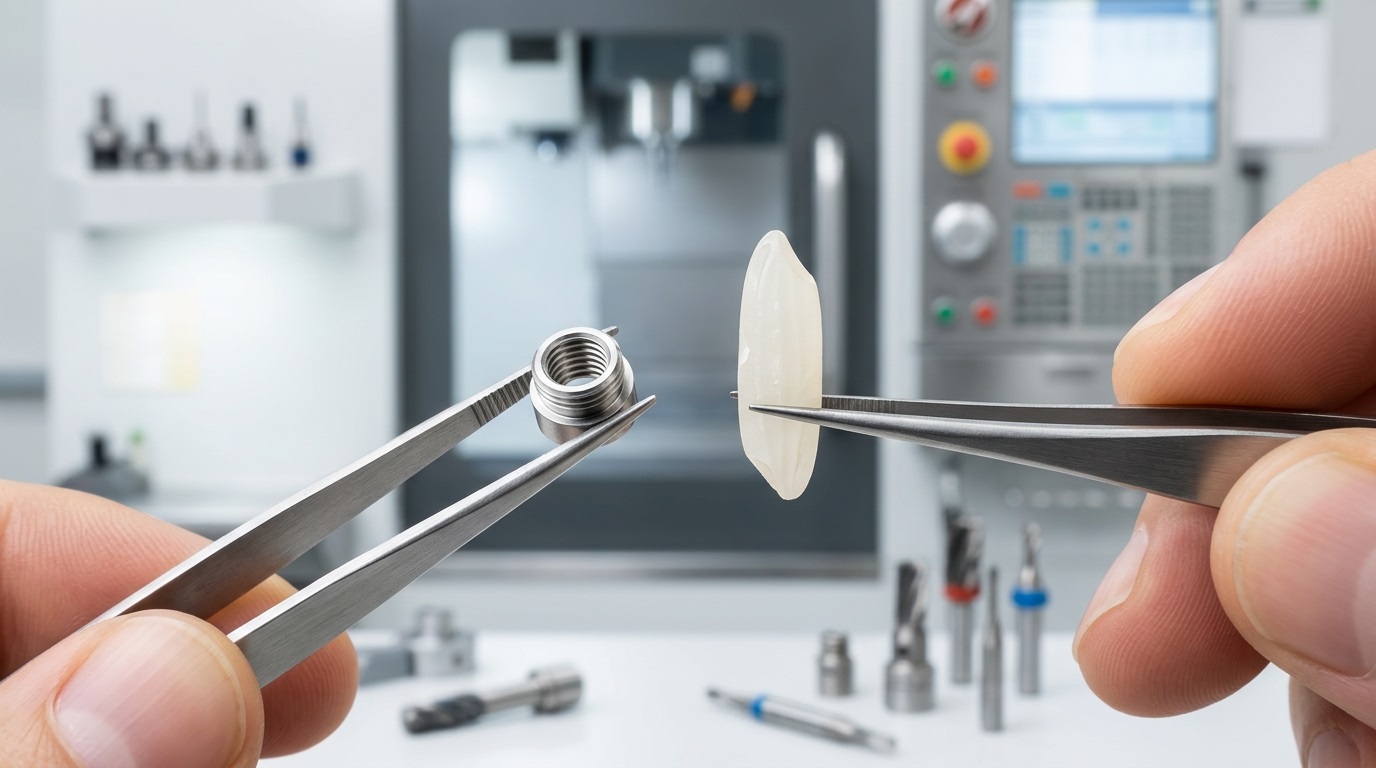
A customer once asked if we could machine a part smaller than a grain of rice, with internal threads strong enough to actually hold a screw. It sounds extreme, and maybe a bit too much, but it wasn’t only the size that mattered. The real question was more like, could it be made accurately, again and again, and without turning production into this much bigger headache?
So, just how small can precision machining really go? There isn’t one single hard stop. It depends on the machine, the tooling, the material, the shape and geometry, the tolerance target, and even on what kind of inspection is required once the part is finished.
Size and Precision Are Different
A small part isn’t automatically a precise part. A tiny component may have fairly open tolerances, while a much larger component can require extremely tight dimensions.
At miniature sizes, even a small measurement error can matter. Dimensional metrology becomes more challenging as features get smaller, so inspection needs to be considered along with machining.
A one-millimeter feature with a loose tolerance is very different from one that must stay within a few microns.
Tooling Sets the Limit
The smaller the cutter, the less space there is for any error. With smaller tools, there is more flexibility, and they can even deflect a bit when cutting forces show up. If that deflection gets too high, it can skew a dimension, ruin the surface finish, or just snap the tool outright.
Spindle speed matters as well, but it really isn’t the only thing in play. The feed rate, tool geometry, the rigidity of the machine, and the cutting conditions all need to line up together, in a kind of coordinated way. This becomes even more important when tight tolerance machining is involved, because there is just less margin to absorb whatever happens.
Material Matters
Material behavior can change the entire machining process. Aluminum is generally easier to cut, while harder steels can increase tool wear and heat. Plastics can create another set of problems because some materials may deform instead of cutting cleanly.
Machinability depends on factors such as hardness, alloy, cutting conditions, and tooling. Machining fundamentals also show why material and cutting conditions need to be considered together rather than separately.
The material still has to suit the application, of course. Strength, wear, temperature, and corrosion resistance may matter more than how easy something is to machine.
What Makes a Tiny Feature Difficult?
Part size isn’t always the biggest problem. Geometry can make a relatively simple part surprisingly difficult.
The common trouble spots are:
- Deep holes: Small holes make chip removal harder.
- Thin walls: Light sections can flex during cutting or clamping.
- Internal threads: Small threads leave less room for error and increase the risk of tool breakage.
- Tight corners: Small internal radii may require fragile tools.
- Limited access: Some features simply don’t leave enough room for the cutter to reach them cleanly.
When several of these appear on the same part, manufacturability becomes much more important. A small change in the design can sometimes make the part considerably easier to produce.
Surface Finish and Inspection
A miniature part can have the right dimensions and still have a surface problem. Roughness can affect friction, sealing, movement, and how two components fit together. Surface requirements may therefore change the machining strategy, finishing passes, or even the manufacturing process.
Inspection gets harder as features shrink. A standard caliper isn’t useful for every miniature feature. Depending on the tolerance, optical inspection or coordinate measurement may be needed.
Measurement itself has limits. Precision measurement guidance highlights the relationship between machining conditions, surface characteristics, and dimensional results.
CNC Isn’t Always the Only Option
CNC machining is a strong choice for many miniature metal components, but it isn’t the answer for every geometry. Micro EDM and laser processes can make certain small or difficult features where a conventional cutter would struggle. Additive manufacturing can also make sense for prototypes or highly complex shapes.
The right process depends on the part, not just its size. Material, quantity, tolerance, geometry, and surface requirements all play a role.
Where Are Miniature Parts Used?
Small machined components turn up in plenty of products. Common examples include:
- Medical devices: Small parts may need corrosion resistance, clean surfaces, and tight dimensions.
- Electronics: Connectors, sensor mounts, and housings often have very little available space.
- Aerospace: Compact components can reduce weight without giving up strength.
- Automotive: Small parts may need to be produced consistently in high volumes.
- Robotics: Compact components have to handle repeated movement and wear.
Those requirements can influence materials and machining methods before production even starts.
Smaller Isn’t Always Better
It can be tempting to make every feature as small as possible. But if shrinking a feature doesn’t improve the product, it may only add cost and risk.
A smaller feature might require specialized tooling, slower machining, extra inspection, or additional finishing. A slightly larger feature may perform exactly the same job and be much easier to manufacture.
Good machining starts with asking what the feature actually needs to do.
Why Manufacturing Experience Matters
Manufacturing problems are usually easier to untangle before anything goes into production. Material, tooling, tolerances, surface finish, inspection, and assembly all sort of tug on each other, especially if you’re working with very tiny features, like the kind you almost “hope” will behave.
A design that looks fine on a screen may turn into a real problem once a micro cutter has to actually reach a feature in the way it was imagined. Looking over those details early can show you where a tolerance can be slightly eased, where one edge can be reshaped, or where a feature can be made simpler.
Miniature machining is not only “making something smaller”. The real challenge is keeping dimensions, surface finish, geometry, and repeatability aligned all at once. For work that involves small features or needs tight tolerances, having precision machining capabilities can help you figure out what’s realistic before the design is fully frozen.
And if you spot manufacturing issues early, you can save time, avoid tooling waste, and reduce extra rounds of rework or redesign. That kind of forethought makes the machining process feel more predictable, while still keeping the finished part’s purpose intact.
Precision That Starts With the Design
At Prizma Works, precision machining kind of sits inside a larger product development flow, like this chain that doesn’t really end at cutting metal alone. Those small-but-critical details, like tolerances, what material you end up picking, the exact part geometry, and the surface finish, all feed into performance and also into how smoothly the component ends up being made. If you spend time on these topics early, before things fully harden into a final design, it can save a lot of extra iterations later on, sometimes even full reworks. From precision machining and prototyping, then through finishing right up to production, the aim stays basically constant: produce parts that match the stated requirements and behave the way they’re supposed to in actual use. And whether the project is a small component or a more involved custom part, leaning into a practical manufacturing approach usually helps keep the balance between accuracy, function, and those real-world production needs.
Frequently Asked Questions
How small can CNC machining go?
There is no single minimum size. The practical limit depends on the machine, tooling, material, geometry, and required tolerance.
What is precision machining?
Precision machining produces components to controlled dimensional tolerances using processes such as CNC milling and turning.
How accurate is CNC machining?
Accuracy depends on the machine, tooling, material, geometry, temperature, and inspection process. Tighter requirements may need specialized equipment and measurement.
What affects CNC machining tolerances?
Tool deflection, machine rigidity, tool wear, thermal changes, material behavior, workholding, and part geometry can all affect tolerances.
Can CNC machines make very small holes?
Yes, but very small holes can create problems with tool deflection, chip removal, and tool breakage, especially when they are deep.
Is CNC machining better than 3D printing for small parts?
It depends on the application. CNC often offers strong materials and good dimensional control, while 3D printing can be useful for complex shapes and prototypes.
How does material affect miniature machining?
Material affects cutting forces, tool wear, heat, surface finish, and overall process stability. The best approach varies between aluminum, steel, plastics, and other materials.