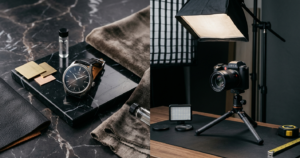
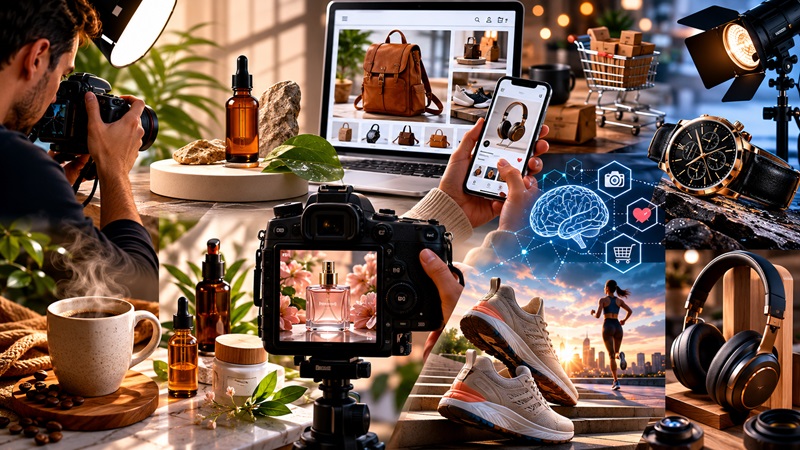
If you’ve ever added something to your cart without reading the specifications, you’ve experienced one of the most powerful forces in modern commerce: visual psychology.
Long before consumers compare prices, analyze features, or read reviews, their brains have already made an emotional judgment. Research in cognitive psychology consistently shows that people process visual information far faster than text, and those first impressions often influence every decision that follows.
For brands, this means product photography isn’t simply about documenting a product—it’s about shaping perception.
The First Impression Happens in Milliseconds
Imagine scrolling through hundreds of similar products online.
One image feels premium. Another feels trustworthy. A third somehow looks “cheap,” even though the product quality may be identical.
What’s happening isn’t magic.
Our brains constantly use visual shortcuts to estimate value, quality, and reliability. Lighting, color harmony, composition, texture, and even the amount of negative space all become subconscious indicators of whether a product deserves attention.
Luxury brands have understood this for decades. They rarely compete solely on specifications—they compete on perception.
And perception begins with photography.
Why the Human Brain Loves Texture
One fascinating aspect of product photography is that great images can make people feel materials they cannot physically touch.
A close-up of leather can communicate softness.
A perfectly lit ceramic mug can appear warm.
A matte metal surface can feel industrial and premium.
This phenomenon is called visual haptics—the brain’s ability to imagine tactile sensations through visual cues.
Exceptional product photographers don’t simply capture objects.
They capture experiences.
Lighting Is Actually Storytelling
Many people think lighting is merely technical.
In reality, lighting is emotional language.
Soft lighting suggests comfort, elegance, and intimacy.
Hard lighting communicates confidence, precision, and strength.
Warm tones evoke nostalgia.
Cool tones suggest innovation and technology.
The same product photographed with different lighting setups can completely transform how customers interpret its purpose and value.
Photography is less about illumination than communication.
Context Creates Desire
A watch photographed on a white background tells you what it looks like.
The same watch photographed on a mountain summit at sunrise tells you who you could become by owning it.
Lifestyle imagery works because people don’t buy products.
They buy identities.
Coffee isn’t just caffeine.
It’s productivity.
Candles aren’t just wax.
They’re relaxing.
Running shoes aren’t rubber.
Their ambition.
The most effective product photography bridges the gap between object and aspiration.
The Trust Equation
In e-commerce, customers can’t touch, hold, or test products before purchasing.
Photography becomes a substitute for physical interaction.
High-resolution imagery from multiple angles reduces uncertainty.
Accurate color representation minimizes disappointment.
Consistent branding builds familiarity.
Detailed close-ups answer questions customers haven’t yet asked.
Every strong image quietly tells buyers:
“You can trust what you’re about to purchase.”
Trust isn’t created by marketing claims.
It’s created by visual evidence.
The Rise of AI—and Why Authenticity Matters More Than Ever
Artificial intelligence has transformed creative workflows.
Background removal is nearly instant.
Lighting can be enhanced automatically.
Shadows can be generated digitally.
Entire environments can be created without a physical studio.
Yet something unexpected has happened.
As synthetic imagery becomes easier to produce, authentic visual storytelling becomes even more valuable.
Consumers are becoming increasingly skilled at recognizing images that feel overly artificial. The brands that stand out are those that combine technological efficiency with genuine craftsmanship, preserving realism while embracing innovation.
The future of product photography isn’t choosing between AI and traditional methods.
It’s knowing when to use each.
Every Product Has a Personality
One mistake many businesses make is photographing every product the same way.
A handcrafted ceramic bowl shouldn’t look like a smartphone.
Organic skincare shouldn’t resemble industrial machinery.
Luxury jewelry deserves a different visual language than fitness equipment.
Every category carries its own emotional expectations.
The most successful brands create photography systems that reflect their product’s unique personality rather than relying on one-size-fits-all imagery.
Beyond Beautiful Pictures
Exceptional product photography doesn’t merely increase clicks.
It reduces return rates.
It improves customer confidence.
It strengthens brand identity.
It communicates professionalism before a single word is read.
In today’s digital marketplace, photography has become one of the strongest business assets a company can invest in—not because it looks beautiful, but because it influences how customers think, feel, and ultimately decide.
Where Creativity Meets Precision
At Prizma Works, product photography is approached as both a creative discipline and a strategic business tool. Every lighting choice, composition, and visual detail is designed to do more than showcase a product—it aims to communicate its value, personality, and purpose.
Whether the goal is launching a new product, elevating an e-commerce catalog, or building a premium brand identity, thoughtful imagery helps create stronger customer connections and more confident purchasing decisions.
In a world overflowing with products, the brands that are remembered are rarely those with the loudest message—they’re the ones with the clearest visual story.
And every compelling visual story begins with a single, carefully crafted photograph.