Design’s done, now what? That’s the point where most people hit their first real fork in the road, CNC machining or 3D printing. Both start from the same digital file, but that’s honestly where the overlap ends. Get this choice wrong and you’re stuck with wasted budget, a blown timeline, or a part that just doesn’t hold up.
Price is usually the first thing people check, and that makes sense, but it can’t be the whole story. Material, tolerances, how many parts you’re actually making, your timeline, and what the part needs to do once it’s finished all factor in here too. Sort this out early and you’ll skip a lot of the back-and-forth that eats up time later.
What Is CNC Machining?
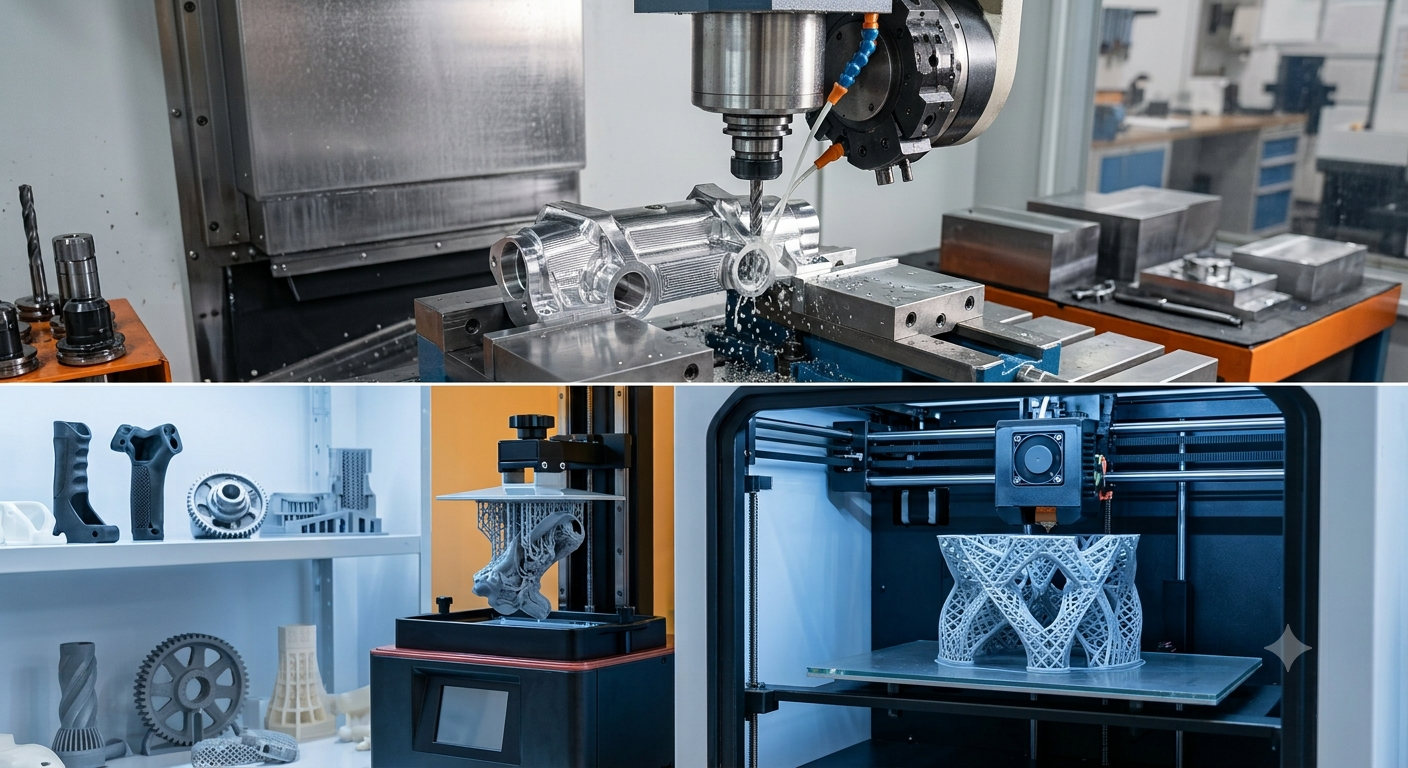
CNC stands for Computer Numerical Control. A computer runs the machine, and the machine cuts material away from a solid block until whatever’s left is your part. People call this subtractive manufacturing since material’s getting removed, not added.
It’s stuck around this long for a reason, it works. Tight tolerances, a clean finish right off the machine, and parts that match up run after run. This is usually where people start when accuracy really can’t be compromised.
Common uses:
- Functional prototypes that need to actually perform
- Parts headed straight into production
- Anything where precision matters most
- Aluminium, stainless steel, brass, titanium, various engineering plastics
Depending on the project, machined parts may also require industrial laser engraving for permanent part identification, serial numbers, logos, or traceability.
What Is 3D Printing?
3D printing, also known as additive manufacturing, runs the other direction entirely. Instead of cutting material away, it stacks material layer by layer, building your part straight from a digital model. Nothing gets carved off, material just goes exactly where the design needs it.
That’s the whole reason it can handle shapes a CNC machine just can’t reach, twisting internal channels, hollow lattice work, curves with no straight lines anywhere. It’s a natural pick for early concept models, prototypes still being worked out, custom jigs, and smaller runs where setting up a full CNC job wouldn’t be worth the effort.
6 Things Worth Comparing
1. Accuracy and Tolerances
Precision matters most? CNC machining wins this nearly every time.
These machines hit tight tolerances consistently, over and over, which counts for a lot when your part has to fit into an assembly alongside other pieces. 3D printing has genuinely improved a lot, but once tolerances get really demanding, printed parts usually still need extra finishing to get there.
2. Material Options
Pick your material based on the part’s actual job, not whatever’s simplest to get hold of.
CNC opens up a wide range of metals, engineering plastics, and composites, the same stuff running through real manufacturing floors every day. 3D printing’s materials have expanded too, but what you can actually use depends heavily on the specific printer and process you’re working with. Not every printer handles every material, and that catches people off guard more than you’d expect.
Need corrosion resistance? Long-term durability? Specific mechanical strength? What’s actually available might end up making this call for you.
3. Design Complexity
This is where printing gets to show off a bit.
Twisting internal channels, weight-saving lattice patterns, organic curves, a printer just builds all of it straight through, no extra tooling, no separate assembly. CNC is limited by something pretty basic though, the cutting tool has to physically reach whatever it’s cutting. So more complicated designs mean more setup and fixturing, sometimes several operations just to finish one part.
Neither one wins outright though. Certain designs just naturally suit one process better than the other.
4. Surface Finish
This affects both how a part looks and how it performs.
A part fresh off a CNC machine comes out smooth with barely any cleanup needed. Printed parts tend to show those layer lines, that stepped texture you can spot and sometimes feel. Want something polished? You’re probably sanding or coating it after the print’s finished. Depending on the application, manufacturers may also apply Cerakote finishing for additional durability and corrosion resistance.
5. Production Volume
How many parts you need can shift this fast.
Just need a few prototypes or a small test batch? Printing usually saves time since there’s no fixtures or tooling to set up first. Once volumes climb though, CNC starts pulling ahead, it handles consistent quality across dozens or hundreds of identical parts more efficiently. Still, don’t decide on quantity alone, design complexity and material needs matter just as much.
6. Cost Considerations
You can’t just line up two quotes and pick whichever number’s smaller.
CNC costs stack from setup, programming, tooling, and fixturing before a single cut even happens. Printing costs lean more on build time, how much material’s used, whether support structures are needed, and any post-processing after.
Generally, printing tends to cost less early on, during design and prototyping. CNC usually becomes the smarter buy once you’re making functional parts or running repeat production. At the end of the day, the cheaper option depends on your specific project, not some fixed rule.
CNC Machining vs. 3D Printing at a Glance
Quick side-by-side if you just want the short version:
| Factor | CNC Machining | 3D Printing |
|---|---|---|
| Accuracy | Excellent for tight tolerances | Good, depends on the tech |
| Surface Finish | Smooth, barely any finishing | Often needs post-processing |
| Material Selection | Wide range of metals and plastics | Varies by printer |
| Complex Geometry | Limited by cutting tool access | Excellent for intricate designs |
| Prototypes | Works well | Excellent |
| Production Parts | Excellent | Good for select applications |
Can You Use Both Together?
Yep, and plenty of teams do exactly this.
A common way to run it: print first to test fit, form, and basic function while the design’s still changing. Once it’s locked in and ready to scale, switch to machining services for the final parts. You get fast, cheap iteration early on, then the precision and durability of machined parts once things are finalized.
Rather than treating these as competitors, it’s more useful to think of them as two tools that genuinely work better as a pair.
Common Mistakes People Make
A little planning upfront saves a lot of hassle later. Watch out for:
- Picking a process based on price and nothing else
- Overlooking how the material actually needs to perform
- Underestimating what tight tolerances really demand
- Assuming prototypes and final parts need the exact same method
- Not thinking about surface finish until production’s already underway
Bottom Line
Neither method wins outright here, they’re just built for different problems.
CNC machining brings precision, repeatability, and material flexibility, a solid pick once you’re heading into real production. Printing brings design freedom and speed, especially useful earlier on when you’re still testing ideas and working through complex shapes.
The right method is whichever one actually matches your design, your materials, your production goals, and your budget. Knowing what each is genuinely good at makes this call a lot easier before you’re already deep into production.
Frequently Asked Questions
Is CNC machining more accurate than 3D printing?
Generally, yeah. CNC tends to hit tighter tolerances and gives a smoother finish than standard 3D printing. That gap’s closing a bit as industrial printers improve, but for now, CNC still holds the edge.
Is 3D printing actually cheaper than CNC machining?
Depends what you’re building. Small prototype batches usually cost less printed. But once you’re into functional parts or repeat runs, CNC often ends up being the better value.
Can CNC machining and 3D printing work together on one project?
Definitely, it happens all the time. A lot of manufacturers print early prototypes to test things out, then switch to CNC once they’re ready for full production.
Which one’s better for metal parts?
CNC machining is usually the pick for metal production parts. It handles a wide range of engineering metals well and gives you solid dimensional accuracy plus long-term durability.
How do I figure out which method fits my project?
Think through how the part gets used, what tolerances it needs, which material makes sense, how many units you’re making, what finish you want, and your delivery timeline. Weigh all of that together and it’ll usually point you toward the right call.